Opening Gambit
I love Michael Jordan’s story and career. Growing up in the 1990s, I was too young to understand his talent beyond watching Space Jam and collecting the Tazos (yes, remember them?!) and hearing of the infamous Chicago Bulls team featuring Jordan, and led by the author of this book, Phil Jackson.
Like many, my admiration for Jordan was rekindled in recent years following the release of The Last Dance on Netflix, a wonderful series that documented the ’96 Bulls team on their way to their final championship as a group. I even got my hands on Jordan’s lesser known work, I Can’t Accept Not Trying, which I blogged about here.
Phil Jackson, the legendary coach who lead that team, then moved onto coach an equally famous group of stars, the LA Lakers, featuring Shaquille O’Neal and Kobe Bryant. Jackson has dedicated his career to creating group harmony among teams of talented, sometimes egotistical athletes. I knew what he had to write about would be worth reading.
In summary
Despite the word basketball not being mentioned in the book’s title or subtitle, the reader should expect lots of basketball analogies and stories! The book is mapped out chronologically, from Phil’s playing career, then coaching roles, mainly at Chicago and LA. Interspersed within the stories of each season, and its highs and lows, Phil reflects on key moments by discussing his leadership lessons, built on successes and failures.
There isn’t necessarily a section of the book that is dedicated to leadership or teamwork theories alone, though, so it’ll mainly be enjoyed by those who are happy to soak up detailed descriptions of championship winning games, locker room fall outs, and Phil’s own views on things that occurred within his teams. As a basketball and sports fan, particularly of this era, I loved hearing more about these teams, as well as the more generic leadership insights along the way.
What is so compelling is Phil’s innately reflective style, and his very deliberate approach to leading teams.
Key takeaways
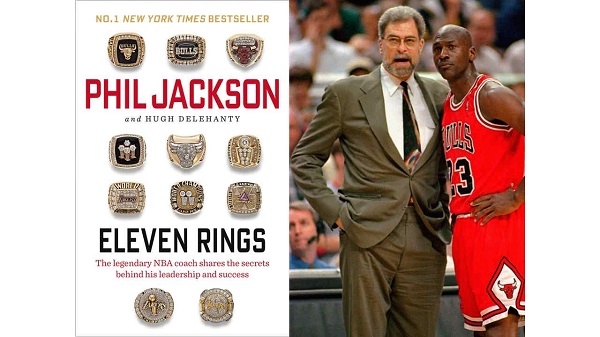
- Symbolism behind what you strive for – in the NBA, winning teams are presented with a championship ring – a very bling piece of kit! But Phil urges teams to work out what they are striving for, and to think about the symbolism of that goal. For him, the ring was a circle, which symbolised the interconnected nature of the team, the quest to find harmony, and wholeness, and to keep moving forward as a group, because circles have no end. So my first takeaway is: what are our teams striving for, and what symbolism, what layers, can we explore within these goals that provide us with depth and narrative that are compelling?
- Freedom to grow – throughout the book, Phil refers to Buddhist and Zen teachings and parables, which I really enjoyed. When talking about giving players more freedom to learn and grow, he used a Shenryu Suzuki story: the mind is like a cow in a pasture. If you enclose the cow in a small yard, it will become nervous and frustrated. But if you give it a large pasture to roam around in, it will be more content and less likely to break loose. Phil believes in having strong structures for some aspects of his team’s way of working, but giving players freedom in other areas. He wants to them think for themselves and have room to learn and grow. As teams, have we considered the structures, freedoms, and environment for learning that we create?
- Daily briefings – Phil starts and finishes every practice session by gathering the group together in the centre court circle to discuss objectives, progress, and feedback for the upcoming, and previous session. This meant that the players and staff kept up a constant dialogue, and it meant their work had purpose and was reviewed. Phil also met with his coaching staff every morning to ensure ultra role clarity and high levels of information sharing – this frequent communication meant they could actually work with more autonomy, because the others had been filled in on what was going on.
- Social Bull’s-Eye – Phil’s favourite psychological team tool involves giving each member a picture of a three-ring bull’s-eye. He then asked each player to mark themselves in one of the rings, based on how connected they felt to the team (the centre being the closest to the group, etc). This allowed the players and staff to share their perspectives on how they fit into the group, and have dialogue about this to steer a way forward.
- Knowing when to pause, wait, listen, let things go – one aspect of Phil’s leadership that really resonates with me, is not being on top of people the whole time. He likes his players to be able to think and make decisions, to solve problems together, and to resolve conflict as a group. Of course, he believes in authority and being tough when necessary, but overall his style is about reflecting, waiting, and not reacting rashly. One quote on this that I liked is: ‘I always welcomed debate, even if it disrupted team harmony temporarily, because it showed the players were engaged in solving the problems.’
There are many, many other deliberate, thoughtful ways that Phil cultivates a strong team ethos, and I really advise you to dig in and find them.
Favourite Quotes
‘What moves me is watching people bond together and tap into the magic that arises when they focus – with their heart and soul – on something greater than themselves. Once you’ve experienced that, it’s something you never forget’.
‘Teams must open their hearts so that they can collaborate in a meaningful way.’
‘Obsessing about winning is a loser’s game. The most we can hope for is to create the best possible conditions for success, and then let go of the outcome.’
‘On a good team there are no superstars. There are great players who show they are great players by being able to play with others as a team.’
Good questions for a player to ask themselves: ‘How do I want to play? How do I need to change?’
‘Great players make other players better.’
Favourite Moment
I was fascinated to read more about Michael Jordan’s return to the Bulls, after an unconventional foray into Minor League Baseball when he was at the peak of his powers as a pro NBA player. When Jordan returned, the team dynamic had shifted, and he had to change his style. He was no longer the figure head that the team was built around. Jackson describes how Jordan’s attitude changed – he became happier to sacrifice his own natural game to play in a cohesive team, and this saw the rise of Scottie Pippin as the man pulling the strings.
‘One thing I loved about this team was that everyone had a clear idea about their roles and performed in them well. Nobody groused about not getting enough playing time, or enough shots, or enough notoriety.’
I can only imagine how hard it was for Phil Jackson to convince Michael Jordan (and later, Kobe Bryant) that in order for the team to be at their best, he would need to conform to team strategy and ultimately sacrifice some of his own abilities in order to share the ball and help the team. And yet, Phil gained Jordan’s trust, and the team flourished.
He exemplifies this ethos through another ancient Chinese story, in which a master asks his followers what makes a wheel strong. When they answer that it must be the strength of the wheel’s spokes, he reminds them that it is the way the spokes are positioned and spaced out that determines the strength and stability of the whole wheel, and not the individual spoke strength alone.
Overall
I really enjoyed this book for the balance of basketball anecdotes, leadership lessons, and the many analogies and proverbs along the way!


Comments
One response to “Eleven Rings, by Phil Jackson”
[…] Supply hyperlink […]
LikeLike