
Teams can be the foundation of organisational success. They can be the best vehicle for good work being done, leading to high-performance, job satisfaction, and growth. But they are also hard work.
With teamwork, you reap what you sow, and the more time and energy you spend investing in your teams, the more chance they have to flourish.
We know from extensive research that healthy, thriving teams are more effective, retain staff, see increased wellbeing levels among the team, and feel a higher sense of purpose and belonging. There are so many reasons to improve teamwork.
Let’s explore how we can turn our teams into successful groups that are more than the sum of their parts!


The research behind high-performing teams:
There is a substantial evidence base that suggests that high-performing teams share certain characteristics, such as:
Vision and Purpose
Values and Behaviours
Systems and role clarity
Belonging, Trust, and Psychological Safety
Goals
Communication and conflict
Debriefs and evaluation
Learning and development
When I wrote The Power of Teams, I created a model which outlines five key areas of teamwork, each featuring some of the most highly evidence aspects of teamwork. My advice for team leaders and those interested in teamwork is to consider each of these in turn, both in a theoretical way, and then more tangibly regarding your own teams.
In The Power of Teams, each aspect of teamwork that you can see below has its own chapter, packed full of cross-sector research, and then more practical strategies for real teams.
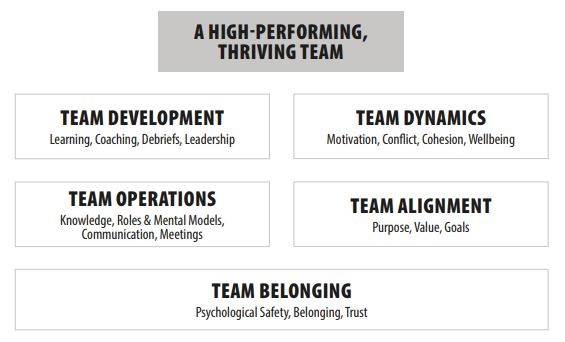
Team Belonging: everyone should belong, feel safe, and be invested in the
team’s values and desired behaviours. Once a team’s belonging, identity and
safety has been established, the team can immerse itself in its core work.
But without this sense of belonging, staff hold back their commitment and
trust. Investment in this area of team life will pay great dividends.
Team Alignment: with the team’s roots established, it can immerse itself
in its core purpose and remit. Together, the team will agree upon why it
is here and what it aims to do, with team goals to work on together. With
alignment, the team can see a way forward and start to plan how to get there.
Team Operations: a high-performing team is well-organised, shares
information and knowledge, and has excellent role clarity and mental
models. Operational areas of team life may provide fewer inspirational
soundbites, but their impact is high leverage; this is the engine room of
team process and performance.
Team Dynamics: team dynamics are just that: dynamic, shifting, live.
It’s important that the team and its leader are aware of motivation theory
and have an understanding of needs models such as self-determination
theory. This helps the team work through conflict, become more engaged
and cohesive, and actively develop dynamics across the group.
Team Development: a learning team is a happy team. There must be
opportunities for the group to learn and to regularly review their work.
Constructive team debriefs add a huge amount to a team’s development,
because a high-performing team considers one of its core remits to be
the capacity to learn and improve. Teams which are committed to their
own growth could start to adopt coaching habits to help unlock each
member’s potential
 Sam Crome