My children love to play-fight with me. Maybe we play too many video games together (Super Smash Bros – just try and beat me as Captain Falcon), but they love to plot my downfall. And good luck to them.
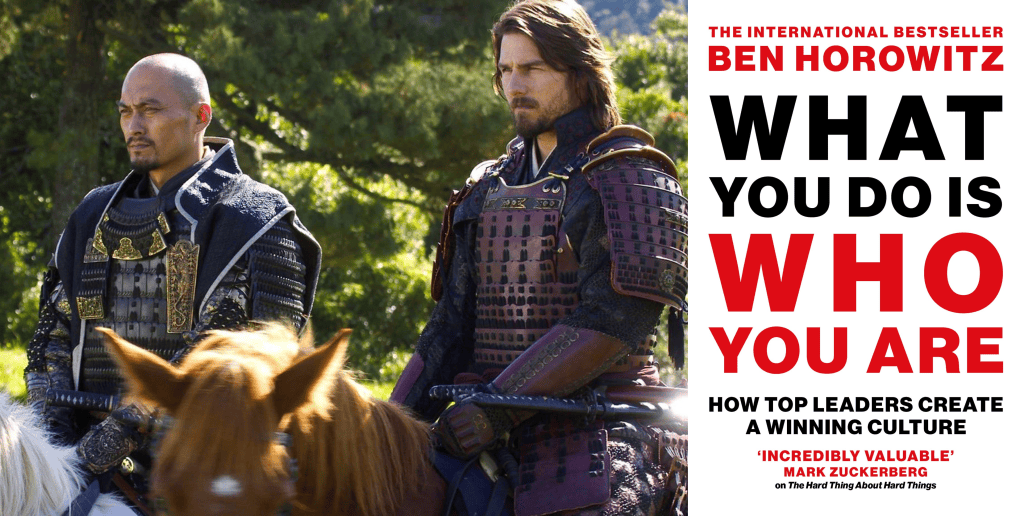
I convinced them that I was trained in the ways of the Samurai almost 200 years ago by Katsumoto (a character from Tom Cruise’s film The Last Samurai), which is why I always had the edge on them. I kept this charade going for a long time, to be fair, but they have now cracked that I’m just an ordinary dad pushing 40, not a 19th century warrior, skilled in the ways of the sword.
Anyway, what I loved about the film, and the reading I did afterwards, was the strong sense of identity that the Samurai had. That sense of who they were, and how they behaved. It was very clear, and shared by all. No ambiguity.
Years later, I encountered the Samurai again this summer when read What you do is who you are, by Ben Horowitz, aptly titled for how direct the author is at challenging the assumptions behind your organisation’s culture.
Before we get into the book, let me geek out briefly about Samurai culture (there is a point, I promise).
Their identity is underpinned by Bushidō, the code of the samurai. It was recorded in the 18th-century text Hagakure, which instructed warriors that ‘the Way of the Samurai is found in death’. A bit morbid? Actually, no.
Indeed, they forged an interesting and familiar connection with death. Every day, each warrior should start in meditation, pondering, among other things, death. Visualise your death, and the various ways you might meet your end. Accept that death is inevitable, and may come today. Do not fear what is inevitable – your death will be honourable if it’s in the pursuit of the Samurai’s aims.
There were various benefits to this, such as not hesitating in perilous situations, grounding yourself in reflection during daily meditation, and living in the present and focusing on what is in the now – also by accepting death by breakfast, you had no fear throughout the rest of the day. Essentially, by normalising the chances of death, you can fulfil the mission of the Samurai without inhibition.
Another aspect of their culture was Shugyō, the daily and repetitive pursuit of mastery. It didn’t matter how good you were at combat or swordsmanship, everyone practiced it every day, making you sharp and subconscious in the way you move. This was non-negotiable. Improvement wasn’t left to chance, and certainly not taken for granted.
Finally, Giri is the concept of mutual accountability. The Samurai had a strong sense of duty and social obligation, and both masters and followers had a strict duty to fulfill for each other – the collective was always more important than the individual, and that’s how decisions were made.
Clearly these were people who understood that mission is lived and not just spoken about. That culture is only created when people do things in certain ways, for certain reasons.
The premise of Horowitz’ book – that actions speak louder than aspirations – spoke to me given some reservations I’ve had about things I’ve read this year about belonging and culture. If we say everyone belongs, how do we actually create a culture where that’s true for everyone? What are the steps?
We all have such good intentions when it comes to culture and belonging. We know that when culture is on point, things tend to get done the way we envisaged, and people enjoy being part of something that feels productive and dynamic. We all want to imagine that belonging and culture are flourishing in our organisations – but sometimes the words I read won’t possibly help people create the actions that are required.
A lot has been written about school culture – I particularly like Ruth Ashbee and Lekha Sharma’s books on this topic – but I want to share the perspective of Horowitz’ book that was written for a range of organisations.
What dictates your culture
At the beginning, Horowitz says that your culture is not defined by those carefully crafted values that some/most of your staff can recite. Those are aspirations, but they aren’t what makes the day-to-day culture alone.
Here are some of his early thoughts on this:
‘Your culture is how your organisation makes decisions when you’re not there. It’s how they resolve problems every day. If you don’t methodically set your culture, then two thirds of it will end up being accidental and it will be a mistake’ Ben Horowitz
He argues that culture is connected to actions and how you approach the nuts and bolts of daily life in your organisation.
Essentially, we should start by identifying the culture we want – what kind of workplace we want to be and the journey we are on, but then, crucially, decide exactly how we are going to get there.
Aspirations are at the heart of any mission statement or set of values, but the standard of your culture is determined by how people behave and respond to things.
Values vs virtues
Building on that, Horowitz states that most organisations have values, which are aspirational beliefs, such as ‘integrity’, ‘equality’, etc. But the issue with these is that they often don’t translate into actual behaviours or actions, making them seem hollow, and not representative of the actual experience that staff have.
This can create ambiguity – ‘well how should I actually behave?’ – and the ambiguity then creates an inconsistent take up of what you intend your culture to be.
He suggests that we adopt virtues instead, which, like the Samurai’s focus on actions, ensure that we will actually do things that we believe in. These must be operational, concrete, and create habitual behaviours.
And that’s exactly what the Samurai did. Let’s say one of their values or part of their mission statement was stated in their employee handbook as ‘Growth’ or ‘Learning’ or ‘Pursuit of excellence’, there is no guarantee that will translate into progress. If one of their key virtues is ‘Every day, everyone improves through training’, then there is now a tangible action that every Samurai, from the least to most experienced, must make. Values can (and often are) be ignored. Virtues are concrete and can be tracked.
I’m not suggesting that all schools create a values list and virtues list, but I do think that many schools overlook the lack of impact their values have. Often called Mission Creep, sometimes leaders assume a certain culture is in place, but, when it is evaluated, it turns out that many in the organisation don’t actually know which values or actions are important. Lack of clarity is a culture killer.
So think about your culture and where it’s supposed to stem from. Where is the place staff are supposed to find it? Your values or mission statement? In briefings? Where is it? Is it clear? Does it translate into actions so that they know how to enact the culture you aspire to?
How do you know what your culture is?
One thing we often encounter with surveys is that leaders overestimate the effectiveness of their work or things in their organisation. How many people follow the behaviour policy? How many people know our key goals?
We should assume we know nothing, and then interrogate to find the truth.
Here’s a great quote from Horowitz on assessing your culture:
‘Your own perspective on the culture is not that relevant; this is rarely what your staff will experience. The real question is – what must employees do to survive and succeed in your organisation? Which behaviours get them included, or excluded from things? What gets them ahead?’
Ask your new staff after a few weeks what the culture feels like. How easy has it been to settle in? Understand the systems? Are there complex social norms to navigate, from parking spaces to what time everyone arrives / stays till? Uncover everything and then ask – is this the culture we set out to create?
Culture isn’t static or ‘finished’
A perfect culture is unattainable. We have never finished. Every day things can disrupt the culture you seek to build, so we have to keep defining our virtues and then walking the walk – both stating and modelling them.
Assumption is the death of good culture, in my eyes.
Without wishing to sound neurotic, I like to sweat the small stuff when it comes to culture. As the children get off the bus – hang on, there’s a couple of shirts untucked today – are we all doing what we say is important when it comes to uniform? Is something slipping?
My job as a leader is to constantly question and consider these things, so that cultural norms become embedded and the easiest way to behave. Clarity and consistency are important here, so nothing can be left to chance.
So culture building begins with identifying what we value the most, and then creating tangible actions that we will all need to perform in order to create that culture.
And because things shift, these might change over time. We can’t assume that things are the same or should remain the same – our schools change and shift.
Sometimes we will find out our culture lacks something – so add to it. Or perhaps there are elements of our culture that we have outgrown and we need to evolve.
We can only do that if we are open to exploring what things are actually like now, and if they are where we wish them to be.
This book is not the culture silver bullet (nor this blog) but it gave me a lot of food for thought that challenged my thinking, especially about virtues / actions, and assuming I know that my culture is.
I’d love to chat more, about my elite training from Katsumoto, or the book. Whatever you like.
Thanks for reading
Sam

